CMC Worship in Place | September 20 | Exodus Series
Getting Egypt out of the people | 20 September 2020
Exodus 16:2-15
Joel Miller
Anytime we’re part of a wider movement I think it’s good to pause a bit and recognize that. So I’m grateful that the Ohio Council of Churches has declared today, September 20, Antiracism Sunday. We are one of many congregations across our state worshiping today in the spirit of repentance and resurrection hope. To borrow some language from Rev Jack Sullivan of the Council, our Christian calling, is to detect, disrupt, and dismantle racism. And as church folks ought to know, anytime you can boil it down to an alliteration, you’re on your way. And of course that work of detecting, disrupting, and dismantling racism starts with ourselves.
I’m a subscriber to The Atlantic magazine and a few years back, 1897, there was an essay in The Atlantic by WEB Dubois. It was titled “Strivings of the Negro People.” In that essay, Dubois talked about double-consciousness. This was an idea he kept developing in later writings. Double-consciousness for the African-American, as Dubois describes it, has to do with seeing the world through one’s own perspective and experience as a self-conscious human being, AND, coming to see oneself through the eyes of a society that views you as a problem.
Dubois starts the essay like this, and I’ll quote the whole first paragraph:
Between me and the other world there is ever an unasked question: unasked by some through feelings of delicacy; by others through the difficulty of rightly framing it. All, nevertheless, flutter round it. They approach me in a half-hesitant sort of way, eye me curiously or compassionately, and then, instead of saying directly, How does it feel to be a problem? they say, I know an excellent colored man in my town; or I fought at…
CMC Worship in Place | September 13 | Exodus Series
Sermon | “Why do you cry out to Me?”
Sermon Text: Exodus 14:10-31
Preacher: Phil Yoder
A story about water
In 2014, the local government of Flint Michigan decided they wanted to save money by switching to a different water source. After switching the water source, the local government did not hold the water plant responsible for making sure that the water was clean, through placing the necessary chemicals in the water, to keep the lead pipes from poisoning the water. This led to high concentrations of lead in the drinking water of thousands of people.
Instead of having access to clean drinking water, Flint residence’s hair was falling out and children were getting sick. Lead poisoning at high amounts can lead to all sorts of health and human development issues. Bottled water, to this day, is still shipped to Flint for people to have clean water access. The government of Flint and of the United States had the ability to dictate who has access to clean water, and thus dictate who lives, and who dies.
Our bible story starts with the Israelites in a sticky situation, stuck between the approaching Egptian armies and the foreboding red sea. They might be asking “Do I die by drowning, or do I die by the sword?” The decision over their own life has been ripped out of their control. Not too different from those in flint, who were stuck asking,“Do I drink poisonous water, or drink no water at all?”
In this peculiar situation, Moses is apparently very calm and collected. He tells the Israelites to “be Still.” That God will fight your battles. Often this is where traditional Mennonites like to end this story. Just be still – See, this God in the old testament isn’t violent. God is telling us not to act,…
CMC Worship in Place | September 6 | Exodus Series
Sermon | Free to give
Scripture | Exodus 5:1-23; 23:19
Sermon: Joel Miller
Mitzrayim. That’s the Hebrew word for Egypt. And, it’s almost indistinguishable from the word meaning a narrow place, or a strait. A place of constriction. The rabbis have long made the connection between the two, sometimes using the words interchangeably: “Egypt,” and “the narrow place.” Mitzrayim. To be in Egypt, is to be confined to the narrow place. To be delivered out of Egypt is to be delivered out of the narrow place.
Last week, when we read about Moses talking with the burning bush/divine voice, it included these words from God: “I have observed the misery of my people who are in Egypt, Mitzrayim, The Narrow Place…and I have come down to bring them up out of that land to a good and spacious land, a land flowing with milk and honey.” Exodus is a story that moves from Order, to Disorder, to Re-Order. It’s also a story that moves from narrowness to spaciousness.
For those of us who have never lived in Egypt but find ourselves often stuck in the narrow place, it’s a way of finding ourselves more directly in this story of Exodus. The narrow place can be anywhere. And during this pandemic we’ve gotten a dose of this as our physical world has narrowed. For those who have been working from home, it can just as easily feel like we are living at work. Even as the places we go have narrowed, we have tried to not let the same thing happen to our minds, to our hearts. The spacious place, the open and broad good land, can also be anywhere, outside, or within us.
Exodus is a narrative, so there’s a pretty big gap between the two readings for today. Exodus chapter 5, and Exodus 23:19.
In chapter…
CMC Worship in Place | August 30 | Exodus series
Sermon Text:
Today’s scripture is about how to talk to a plant.
Step one, go out in the wilderness. Some sheep for companionship are optional.
Step two, when a flame of light reflects just so from the leaves of a bush or tree or from a blade of grass, then it’s time to turn aside and walk toward it, that’s the one.
Step three, when the plant calls your name, you say “Here I am.”
Step four, take off your shoes and settle in. You’re not going anywhere for a while.
Feel your feet pressed onto the ground. Feel it holding you up. Know that the plant has pressed its feet even further than yours, deep down into the earth. There are things, wondrous things, going on down there you’ll never see or know.
Now you’re ready to listen.
Plants like to talk about responsibility and freedom. You’re listening, and it speaks: “Your people are in misery and they need you. You must lead them. You will lead them out of bondage into a broad and beautiful land. A land of abundance.”
To a plant, responsibility to one’s purpose, and spacious freedom are the same thing.
You may not like how serious this has become so quickly. The plant is not particularly concerned about your feelings on this one. It’s met your kind before.
For your part, you need a little more. A little more…assurance, clarity…What is it that you need? A name, you need a name. “When they ask who sent me, what should I tell them?” You know, asking for a friend. “What’s your name?” you say.
The plant has an answer. It has to do with God.
Plants like to talk about God. Or, plants are messengers for God. Or, if you prefer, God is speaking out of the plant. “I will be who I will be” the God/plant says. …
CMC Worship in Place | August 23 | Exodus series
Order of Worship
Prelude
Welcome
Call to Worship
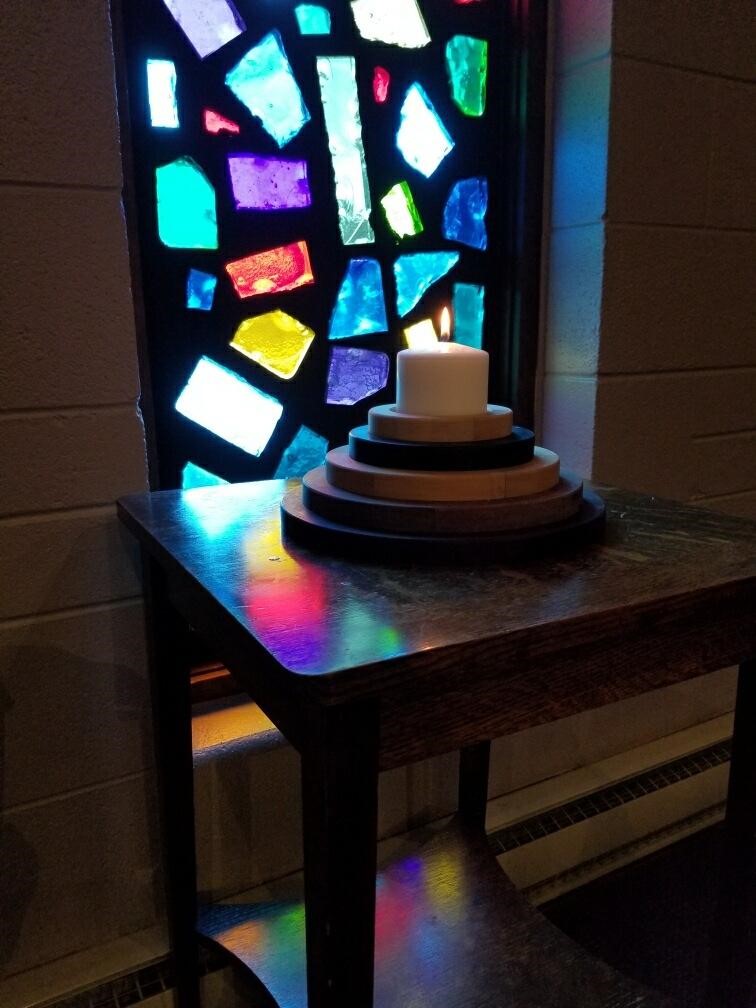
Peace Candle
As we worship in place today, we light a Peace Candle in our home.
May this flame be a sign of our prayer for peace within us, among us, to the ends of the earth.
The flame joins us in spirit across distance, along with our sister church in Armenia, Colombia.
Music Commentary
HWB 366 | God of grace and God of glory | Fred Suter, Marlene Suter, Julie Hart, Phil Hart
Children’s Time
Offering/Dedication Prayer
HWB 164 | When Israel was in Egypt’s land | Phil Hart
Scripture | Exodus 1:8-2:10
Sermon | Things To Do When You Fear God
Silence
HWB 446 | Wade in the water | Steve Rolfe, bass; Tom Blosser, piano;, Alexander Martin, violin, Phil Hart, guitar and vocals
First Fruits Announcement
Sharing of Joys and Concerns
Pastoral Prayer
Extinguishing the Peace Candle
Benediction
Thanks to everyone who led today’s service:
Sermon: Rev. Dr. Jack Sullivan Jr., Ohio Council of Churches
Worship Leader: Julie Hart
Music coordination and commentary: Phil Hart
Children’s Time: Stried Family
Peace Candle: Meaghan Torres
Scripture Reading: Meaghan Torres
First Fruits Announcement: Scott Applegate
…