Text: Luke 24:13-35
Speaker: Joel Miller
When I say Christ is Risen, you say Christ is Risen Indeed!
Christ is risen….
Christ is risen….
For an Easter story, the journey to Emmaus is remarkably, unremarkable. If you’re looking for flashing lights and earth-shaking spectacle, you’ll find it at the empty tomb – earlier Easter morning. Early at dawn, Mary Magdelene and other women bring spices to care for Jesus’ body. They arrive and find – to their great confusion – no body, no Jesus. Instead, they’re met by two men is dazzling clothes who announce that Jesus is not here. He has risen.
That’s how Luke tells it.
Matthew adds more layers of drama: As soon as the women arrive at the tomb there is a great earthquake. An angel with the appearance of lightning descends from heaven, rolls away the stone guarding the tomb, and sits on it. And says those same words. He is not here. He has been raised.
Mark and John convey a similar message: something earth-shattering has just happened. The thin veil between earth and heaven, the material and the spiritual, has been pierced. Jesus, who was executed, publicly crucified in Jerusalem, dead and buried, has been raised. Don’t look for him among the dead. He. Is. Not. Here.
Which opens the question: Then. Where. Is. He?
This is the question hanging in the air as Luke transitions to the Emmaus Road story:
Luke 24:13: “Now on that same day (empty tomb day, Easter Sunday) two of them were going to a village called Emmaus, about seven miles from Jerusalem, and talking with each other about all these things that had happened.”
This piece, called “Emmaus Road: Breaking Bread” is displayed in that back corner of the sanctuary. The artist, Matthew Regier, includes three key elements of this story.
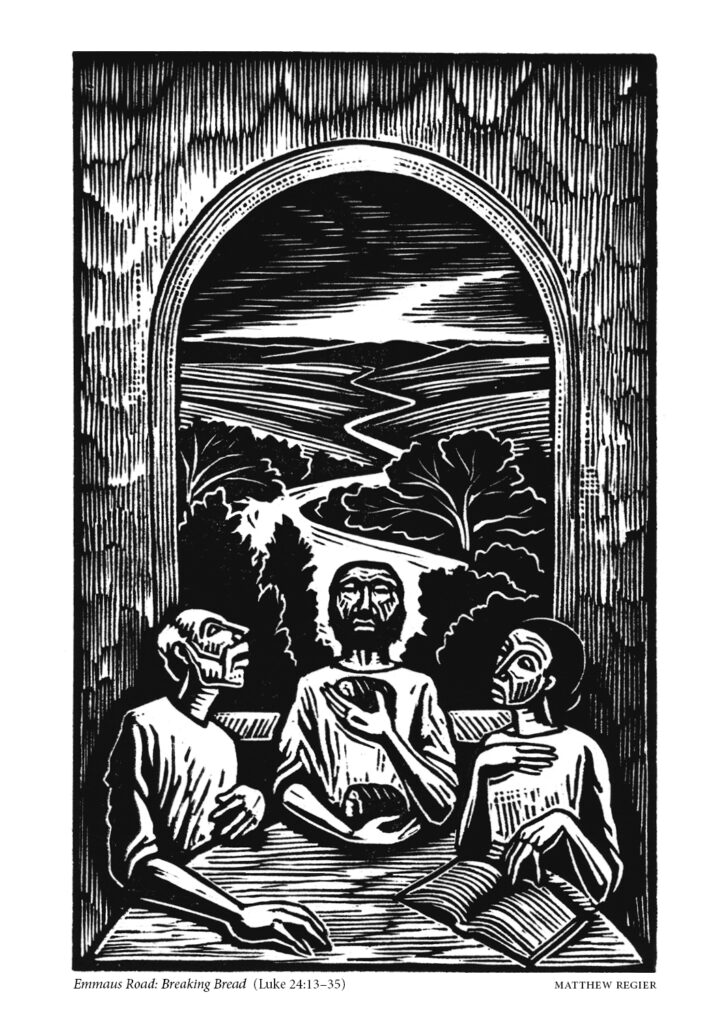
There is, of course, the road. A road is a fitting metaphor for the faith journey. Our story, like this one, unfolds on the road.
But this is a particular road. One with dust and stones and hills. It’s that seven-ish mile stretch between Jerusalem, where everything had just happened, and Emmaus, a village so obscure scholars still aren’t sure where it was. This road is where those two disciples, walking away from the center of the world, Jerusalem, toward obscurity, encounter a third traveler, who comes alongside them. They talk the whole trip. Luke tells us it’s Jesus. Here he is! But these disciples don’t recognize him.
There is the road, and there are the scriptures.
As they walk along, these two disciples tell their fellow traveler about their grief over what they had just witnessed – the violent death of their master, the one in whom they had placed their hopes for the redemption of Israel and the world. Toward of the end of the journey, this third traveler says that it was inevitable that the Christ would suffer. This is what he had told them all along. This is where the scriptures come in. Luke writes: “Then, beginning with Moses and all the prophets, he interpreted to them the things about himself in all the scriptures.” In other words, these disciples, and we, are being offered a new way of seeing – a new hermeneutical imagination – through which to interpret scripture and history. Starting back at the beginning, and re-reading the whole story through the eyes of the ones who suffer. The eyes, as Dr. King’s mentor Howard Thurman named it, of the disinherited. Scripture through the eyes of Christ, who was there in the story along.
At this time the Hebrew scriptures were a collection of scrolls rather than a tidy singular book, definitely not something you can carry in your hiking backpack, so Matthew Regeir takes some artistic liberty in showing one of the disciples with an open Bible at the table.
But we get the point. Jesus is known to us as the fellow traveler on the road. And Jesus is known to us through the scriptures.
Except that he isn’t. Jesus has just preached a Bible-based sermon about himself to listeners eager to know the truth, and they still don’t recognize him. It’s almost as if sermons don’t instantly change everyone’s mind.
There’s the road. There are the scriptures. And there is the bread.
When the disciples reach Emmaus, their new friend walks ahead as if he’s got other places to go. But it’s getting dark, and they invite him in. They offer him a meal with bread. And something happens with the bread that startles them into recognition. This unknow traveler, takes the loaf of bread, and he blesses it, and breaks it, and gives it to them. The same way Jesus had blessed and broke the bread, and given it to the crowd of 5000 who had come to hear him teach. The same way, on the last night of his life, Jesus had taken, and blessed, and broke the bread, and given it to his disciples, saying, “this bread is my body” as if they, in eating the bread, were somehow becoming part of that body, forever included within the body of Christ which extended beyond the physical body of Jesus.
And that’s when, around that table in Emmaus, as Luke says, “their eyes were opened, and they recognized him.” And that’s when, Luke goes on to say, he vanished from their sight.
The road, the scriptures, and the bread.
This is good and fine, but there’s nothing new here. Certainly nothing remarkable. These are the elements that have been there all along.
Surely these disciples had walked alongside Jesus on a road before. And Jesus referenced scripture all the time in his teachings. And how often had Jesus broken bread with his friends and challengers? When Jesus taught his followers to pray, it included bread. Give us this day our daily bread.
So why did it take so long for these disciples to recognize Jesus?
The text doesn’t say. Which is fun. Because it presents another open question we get to live with.
Why does it take so long to recognize Jesus?
Here are two possibilities.
One is that these disciples are so overcome with grief they simply can’t see past the devastating loss. It was very, very fresh. Days, not weeks. And it was, in the language we have come embrace to describe such deeply imprinting experiences, traumatic. It was brutal. And it was final. And that was the end.
They aren’t silly or dim-witted. They are mired in grief.
There’s a quote attributed to the writer Jamie Anderson that says: “Grief is love with nowhere to go.” And while grief may include more than just that, it certainly can be that. All the love and hope and longing built up through knowing Jesus, now had nowhere to go. It’s all pooling up in front their eyes, as grief tends to do. As grief for a loved one, or grief for the suffering of our world, tends to do. It can be hard to see anything else but that, when grief is love with nowhere to go.
Maybe that’s why these disciples didn’t recognize Jesus.
Or, and, and/or, maybe Jesus didn’t look like Jesus.
This is what another artist imagines.
Due to copyright we are unable to post the image here. Link HERE to see.
This is simply called “Emmaus.” It’s by the Filipino artist Emmanuel Garibay. It shows that same scene, the disciples and Christ around the dinner table in Emmaus, with a significant twist, or two.
The Christ figure, noticeably, doesn’t look like Jesus. At least not a first century Jesus of Nazareth. They could be meeting in a pub. The bread has apparently been consumed, and so we are peering into that astonishing moment after the disciples have finally recognized it is Jesus, the Christ, and before she vanishes. If they had been overcome with grief, then no more. Now, they are overcome with laughter. The hilarity is so intense they are convulsing, their bodies barely able to contain what their eyes have finally seen.
This, too, they suddenly realize, is what she had told them all along. That Christ would be present in those they least expect – the hungry, the thirsty, the sick, the prisoner. Lord, when did we see you this way? “I was a stranger, and you welcomed me in” (Matthew 25).
They hadn’t seen it till now. But now they see.
On the journey to Emmaus there are no earthquakes. There are no dazzling clothes like lightning. And there are no descending angels giving a public service announcement about a startling divine rupture in the fabric of the universe.
But there is an earth-shattering change in consciousness, mediated through the most ordinary of encounters.
Where is Jesus now? She’s been there all along. On the road. In the scriptures. At the table. Even, even there within the grief. Her hands bear the nail marks. She has suffered, but is so much more than a victim of state violence. Can you believe it? How could we not have seen this before?
And just so these newly revived disciples, still almost falling out of their chairs due to the rapid neurological rewiring changing how they see the world -just so they don’t latch on to any singular form of the risen Jesus, she vanishes from their sight.
She’s gone.
They are left with an empty plate, empty bottles, an empty chair, and hearts so full they can hardly contain it.
Jesus is not in the tomb. He is risen. And these disciples, when they finally regain their composure, rise from the table. They rise – resurrected with a new way of seeing. They rise – the compost of their grief blooming with new life. They rise next to that empty chair, still stumbling a bit with laughter – their love with nowhere to go transformed into love with everywhere to go. Everywhere to go. Every person, every form creation takes, a potential embodiment of Jesus. Every scripture, every text, a potential revelation of the dying and rising Christ. Every road a possible path toward redemption.
If grief is love with nowhere to go, then resurrection is love with everywhere to go. And so they go, these two friends, and tell the others what happened on the road, and how Jesus was made known to them in the breaking of the bread.