CMC Worship in Place | Easter 4 | May 3
Easter 4
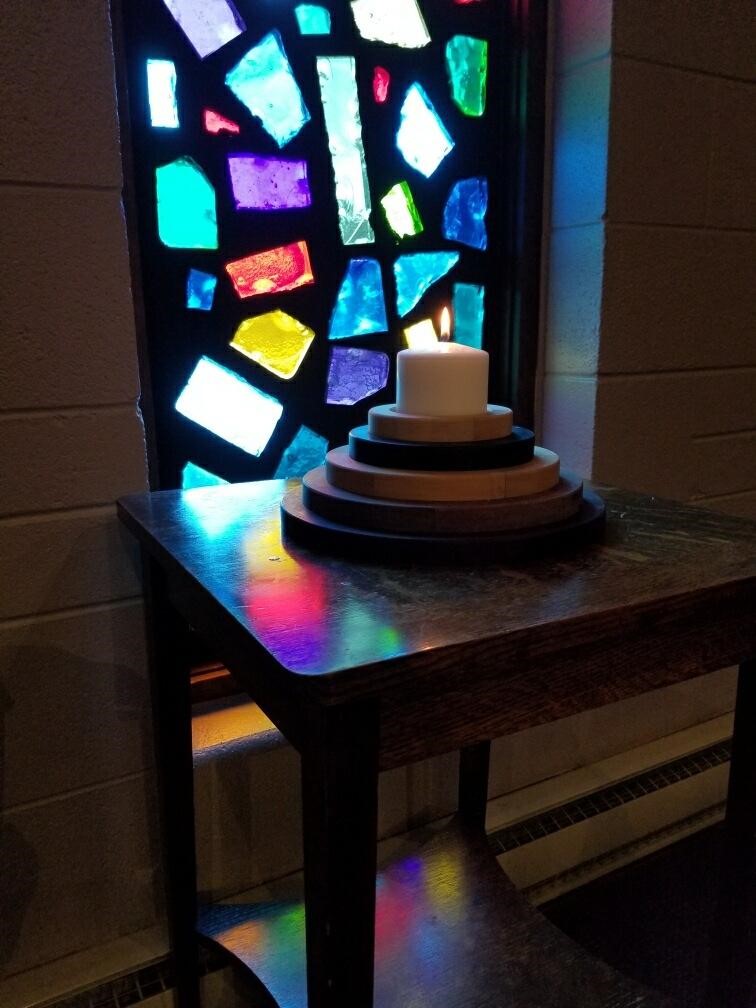
Peace Candle | Erin and James Neese
As we meet today in spirit but not in person, we gather around these Sunday Meditations offered by members of the CMC community. Just as we light the Peace Candle to begin our worship, you are invited to light a candle for these Meditations. The flame joins us in spirit across distance, along with our sister church in Armenia, Colombia.
Welcome, Opening | Julie Hart
Call to Worship | Julie Hart
HWB 519 | Shepherd me, O God | Jodi Quint
Scripture | Psalm 23 | Carolina Neese
Children’s Time | Ryan Hoke
Mission Moment | Peace and Justice Support Network | Melonie Buller
Pastoral Prayer | Charlie Shenk
Special Music | Bright Morning Stars | Jodi Quint
Scripture | John 10:1-10 | Erin Neese
Sermon | We, like sheep (and chickens) | Joel Miller
Hymn | Could it be that God is singing?
Benediction | Julie Hart
Christian Education | A scientist’s perceptions of our present reality | Interview with Dave Denlinger
Cookie Sunday | 11:00 am via Zoom
Sermon | We, like sheep (and chickens) | Joel Miller
After several months of worship themes unique to our congregation, we’re back on the lectionary. We’ll stick with it throughout May and maybe beyond.
One benefit of the lectionary is the consistent cycle of the liturgical year. No matter what’s happening in the world, any given year, these Sundays between Easter and Pentecost always place us within the Easter season. With the headlines giving the appearance of an eternal Lent, this is a good thing.
Another lectionary gift is that the “our” and the “us” and the “we” involved are universal. This morning Christians around the world are looking at these same texts, pondering the same startling possibility of Easter’s extended appearance.
As a bonus, this year offers a wonderful liturgical convergence across religions with Muslims observing Ramadan, and Jews counting the days between Passover and…

CMC Worship in Place | Easter 3 | Keep CMC Safe From Abuse | April 26
Special thanks to Elisa and Matthew Leahy for video production
Welcome | Jerry Nussbaum
As the Psalmist proclaims with these words :
24” This is the day that the Lord has made;
let us rejoice and be glad in it.” (Psalm 118:24 English Standard Version (ESV)
Here we are, again, invited to worship in place, where you are right now.
These are indeed new and changing days, learning new ways to be together without being together. Saying to friends and family “I’m not taking visitors right now…let’s connect by phone or Skype.”
Maybe you are fortunate and able to work from home.
Some may wonder when will my business open again, when will I be called back to my job. Will my loved one recover from this illness. There seems to be a perpetual state of grieving. Grieving which takes a lot of energy and patience. You may feel tired. Everything takes a little more effort.
How long can this last? When can I visit with my family or friends. If your loved ones or friends are in the hospital or nursing home visits if permitted at all can be very limited.
Are you finding a place for hope? For renewal of a tired and uncertain spirit? When is the last time you stepped outside or looked out of the window? Have you noticed the flowers, the redbuds, the tulips, the birds singing or even those fading blooms, that remind us that life comes to us again and again just like the sun rises and sets again and again. Our scientists have observed that the earth as a whole is quieter now; the air, cleaner and the skies clearer.
I hope that today wherever you are there will be some space to just breathe again. The let the artist inside find new life,…
CMC Worship in Place | Easter 2 | Creation Care | April 19
Sunday Meditation | Easter 2 | Creation Care | 19 April 2020
Special thanks to Elisa and Matthew Leahy for video production.
Welcome and Call to Worship | Cindy Fath
For many, even most of us, the past month has meant that we find a new way of life. For me, it meant creating a workspace in a room at home from which to facilitate classes for my ESL students. I suspect we’ve all found a new rhythm in our routines all the way from our tinies to our seasoned citizens.
What you may be less aware of is that our earth has also found a new routine. Our world has been forced into a rest, a pause. Covid-19’s globe-zigzagging impact has reminded us that nothing happens in isolation, that what affects one part, also affects the other, just as in the Body of Christ. We are truly all in this together.
Today is Earth Sunday and we hope to together learn more about what it means to care about and care for creation, all the while giving honor to our Creator. After God brought our planet into being, God pronounced it as very good. And don’t we resonate with that description? Maybe the pause we are experiencing has given you reason to walk around your neighborhood or putter about your yard more and behold the delights of new growth and life in this season of spring.
Let’s join in reading:
Leader: Lord, you placed us in your glorious creation, into the garden you made for each of us.
People: You alone are the Lord. You made the heavens, even the highest heavens and all the starry host, the earth and all that is on it, the seas and all that is in them.
Leader: You give life to everything and the multitudes of heaven worship you. How many…
CMC Worship in Place | Easter | April 12
Easter
Special thanks to Elisa and Matthew Leahy for video production and Tom Blosser for music coordination.
The Cross and Resurrection
Prelude | In the bulb there is a flower, for quartet | Myers Family
Peace Candle | Al & Kathy Bauman, JoAnn and Paul Knapke
Opening Words | Jen Cartmel
Call to Worship | Inspired by Luke 1:78-79; John 1:4-5; John 11:25 | Cartmel/Plessinger Family
Leader: Come to me, all you who sit in darkness
and in the shadow of death!
Everyone: On you has the light shone!
Leader: For Jesus Christ is the light of the world
and this is the story;
Everyone: the light shines in the darkness
and the darkness could not put it out!
Leader: Jesus said,
“I am the resurrection and the life.
I am the bright and morning star.”
Everyone: We join with the angels in their hymns of praise;
Glory to God in the highest
and on earth peace, Alleluia!
Leader: Christ is risen!
Everyone: He is risen indeed!
— adapted from Carole Penner, and posted on her Leading in Worship blog.
Easter Greetings from afar | Organized by Phil Hart
Comunidad Cristiana Menonita de Paz – Our sister church in Armenia, Colombia
Yasir Makki, Sudan
David Emch, serving in Thailand
Hymn | HWB 280 Christ the Lord is Risen Today | Tom Blosser
Children’s Time | Elisa Leahy
Hymn | Anita’s Song: Love is a Beautiful Thing | Tom Blosser
Love is a beautiful thing.
Let’s spread it all over.
Love is catching on.
Let’s pass it on, pass it on, pass it on.
Pastoral Prayer | Mark Rupp
God of resurrection and new life, give us eyes to see, ears to hear, and hearts that are open to your presence walking with us along this road of life.
For those of us who still find ourselves re-treading the footsteps of hopes unfilled, asking ‘where did it all go wrong’, we pray that in our breaking open we would find you there.
For those of us…
Good Friday Service | 10 April 2020
Good Friday | 10 April 2020
Prelude | Ah, Holy Jesus,* Johann Cruger (1640) Arr by John Carter (*HWB 254) | Tom Blosser
Welcome | Joel Miller
Call to Worship | Miller Family
On this night, as the shadows deepen,
We come to be present with Jesus.
With the glory of Palm Sunday behind us and the victory of Easter not yet come,
We will sit together, although apart, with our listening and breaking hearts.
In this world that is at once beautiful and tragic,
We seek to be present with all who suffer.
We will be present with ourselves
In the dark valleys of life, when sorrow threatens to overwhelm,
We long for a safe and sacred space to sit with our grief and our questions.
Jesus Christ, holy friend,
we know that you are here with us.
Let us be here with you. Amen.
Hymn | STJ 105 Don’t be afraid | Tom Blosser
Prayer of Confession (from Psalm 51) | Mark Rupp
Have mercy on us, O God, according to your steadfast love.
According to your abundant mercy, blot out our transgressions.
Create in us clean hearts, O God,
And put new and right spirits within us.
Assurance of Pardon | Mark Rupp
God will not cast us from the Divine presence. God will not take the Holy Spirit from us. God forgives and restores. May the peace of Christ be with you.
Silence
Prayer | Mark Rupp
Holy, loving, suffering God,
Give us eyes to see
the injustice and suffering that abound.
Give us hearts to feel
the depth of this world’s brokenness.
Give us ears now to hear
the words of your passion.
Amen.
Hymn | HWB 241 Tis midnight and on Olive’s brow | Tom Blosser
TENEBRAE
THE DEAL | Carolina Neese
Luke 22:1-6
Hymn | VT Sampler 4, Stay with me, the night has come | v. 1 “Stay with me…” | Abbie Miller
THE ROOM AND TABLE | Haley Behnfeldt
Luke 22:7-23
Hymn | STS 77 Here is the bread | Tom Blosser
THE GARDEN…