Text: Luke 22:7-30
Speaker: Joel Miller
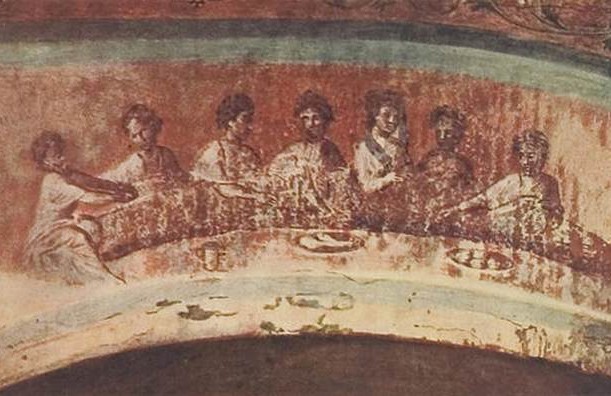
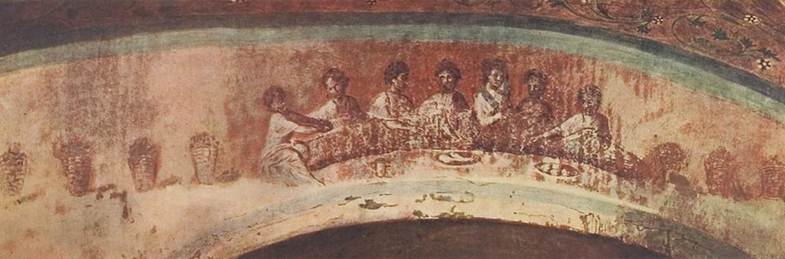
The image on your bulletin insert is old. It definitely looks old. To see it, you have to go underground. It’s a fresco painting found in the Catacomb of Priscilla in Rome, still there. It has been dated as early as 100-150 CE, which means it could have been painted before all the books of our New Testament were written. It’s one of the oldest preserved Christian artworks. It’s possibly the oldest preserved portrayal of…well, What is this going on here??
If you’re getting Last Supper vibes, you’re on to something. These folks are gathered around a meal table. The person on the left is holding up a small loaf, ready to break it and offer it to the others. The painting is called “Fractio Panis.” Fractio, like fracture, to break. And Panis, like pan, which the Spanish takes from the Latin for bread. Fractio Panis, “Breaking Bread,” like we still do at the Communion Table. The two-handled cup near the bread-breaker would contain that other familiar element, the wine.
But this isn’t Jesus and his disciples, like what Leonardo da Vinci would paint centuries later. There are seven people around the table, not 12 plus one. Who are these people? What are there names? We don’t know. Traditionally, it has been held that this is six males and one female. Although modern scholarship has looked more closely at the dress and hairstyles and suggested that most or even all are female. The scene is likely an early house church. While the state-sanctioned sacrifices of Rome continued to reinforce the dominant order of gods and men, early Christians were practicing an alternative sacrificial meal with its own symbolic universe. It presented a different kind of ordering. The kind Jesus saw himself bringing into the world.
And – There’s more going on here than just the ritual of Communion or Eucharist. In the middle of the table is a plate with two fish. On the right is a plate with five loaves. On both sides of the table are baskets, overflowing. Four to the left, three to the right, seven in all. These plates and baskets reference an earlier story in the gospels, actually two stories, very similar to each other, just different numbers involved – the feeding of the 5000, and the feeding of the 4000. People had gathered in the wilderness to hear Jesus teach – thousands of people – and it’s getting late in the day and nobody knows where dinner is coming from. Jesus finds five loaves and 2 fish. He takes the loaves of bread, blesses them, and breaks them, fractio panis, and gives them to the disciples to share with the multitudes. Everyone eats, and has their fill. When the disciples collect the leftovers, they fill up seven baskets – that’s the Feeding of 4000 version. And here those elements are, on and surrounding the table of this house church. Five loaves, two fish, seven baskets.
The story of the Last Supper and the stories of multiplication and abundance and breaking-of-bread-as-building-of-beloved-community, enough-for-all, all this in this old, underground painting.
If you were here at the beginning of this Courageous Peace Witness series, way back to Labor Day weekend, you may remember we started with a parable – The Parable of the Cross. The suggestion was that this Roman symbol of domination through brutal violence, unity through scapegoating, became, through Jesus, a symbol of Divine solidary with suffering, and community through reconciliation.
Having started with a parable, I thought we could end with a parable. This time, it’s a parable about something so common, so every day, it’s as easy to miss as a looming cross is impossible to miss. We’ll call it The Parable of the Bread and Cup.
The thing about a meal, food and drink – whether it be bread or rice or corn or yams; wine, juice, or water – the thing is, we all do it. We all have to eat. It’s something every person – from the most powerful to the least, from the youngest to the oldest – has to do to stay alive. Everything alive stays alive by eating. I take something that is not me, I break it with my knife or hands or teeth, it goes into my body, and it becomes part of me. It’s an everyday miracle.
What the ancients understood about eating is that it has to do with boundaries. The boundary between the body and the world. That thin, fragile sacred line between life and death. It’s a line that has to be crossed in order to keep living. Like every boundary, it’s one that needs protected with certain protocols, certain rules, practices, guidelines. What all can we eat? What must not be eaten, for our own good? These days it’s nice to have the USDA, FDA, and local health departments doing a lot of the screening for us. That way our expiration date doesn’t come needlessly ahead of schedule.
What the ancients also understood, is that there is a social body. The community, the collection of individual bodies, functioning together, takes on the qualities of a single collective body. This body too has boundaries, sometimes borders and walls. It has certain protocols of what is allowed in and what, like a disease or pollutant, must stay out. Because that body too wants to live. The social body wants to maintain and sustain itself.
In the gospels, especially Luke, it’s the meal table where these worlds of the individual and the social body, and the spoken and unspoken rules around who and what is allowed where and when and with whom are all baked together.
The thing about Jesus is that he seems remarkably unconcerned about the preservation of those rules. He keeps messing with the guidelines that keep the social body operating at equilibrium where everything and everyone stays in its place.
Like that time Jesus is eating at the home of Simon the Pharisee, and a woman Luke labels as a “sinner” just comes right in. She starts pouring expensive oil on Jesus’ feet, wiping them dry with her hair – right there at mealtime. How is any of this OK? Simon asks, more or less. It’s OK Jesus says. It’s more than OK. She showed me more hospitality than you have. (Luke 7)
Or that time Jesus is walking through a grainfield, hungry, and starts plucking off heads of grain, rubbing them in his hand, and eating them. No big deal, except that it’s the Sabbath, a time protected from anything resembling work. What is the Sabbath for if not for satisfying hunger? Jesus questions. (Luke 6)
And that parable Jesus told about a son who asked for his inheritance early. His father gave it to him, everything due to the son upon his father’s death, his father, still very much alive, gave the son. And so they became, socially, dead to each other. The son took it all, went away and spent every last penny. Desperate, he came wallowing back home, a shame to himself, a double dishonoring of his father’s household. But the father ran and greeted him, threw his arms around him, and threw a great feast in honor of his son who was lost but had been found. That’s not protocol.
These are just a few of many examples.
When the prophet Isaiah, centuries before Jesus, was imagining the restoration of all things, he pictured a great feast. In one place Isaiah writes: “On this mountain, the Lord of hosts will make for all peoples a feast of rich food, a feast of well-aged wines…Then the Lord God will wipe away the tears from all faces, and the disgrace of the people God will take away from all the earth” (Isa. 25) In another place Isaiah writes, “Ho, everyone who thirsts, come to the waters; and you that have no money, come, buy, and eat! Come buy wine and milk, without money and without price” (Isa. 55).
These words, read often at synagogue, memorized by the faithful, must have lodged themselves deeply within Jesus’ imagination. And, at some point in his young life, he must have thought, Why wait? Why not start living as if the restoration of all things is already happening? What if it starts with something as common as the meal table?
Matthew, Mark, and Luke all tell the story of the disciples arguing over who will be the greatest among them. But only Luke places this argument at the supper table at the end of Jesus’s life, right after he has offered the bread and cup. A table was a place that had its designated places of honor. Order and boundaries. You knew where you stood in the pecking order of society by where you sat around the table. So who gets to be at the right hand and the left hand of Jesus? Jesus replies: The kings of the Gentiles – the emperor, the governors, and client-kings – lord it over others. That’s not how we’re going to do it. Around this table, the greatest will be the one who serves. The throne-room of the kingdom of God is like seats around a table with a meal spread out for everyone where the servants are in charge. And we’re all servants.
The organizational consultant Peter Block writes: “Our work is to shift the narrative by ensuring that each time we come together becomes an example of the future we desire” (Community: The Structure of Belong, p. 2). He wasn’t writing specifically about church or communion, but it fits. “Our work is to shift the narrative by ensuring that each time we come together becomes an example of the future we desire.”
When Jesus, at the final meal with his closest companions, took a loaf of bread, and broke it, and gave it to them, and said, “This is my body, which is given for you. Do this in remembrance of me,” he understood how bodies work. Individual bodies, and social bodies. He knew his own body, the body that had taught and healed others, the body that had been anointed by that woman’s oil, the body that had broken bread in the wilderness so everyone had enough – he knew that body was about to expire. And he knew bodies are sustained by taking in what is not them, and making it part of their self. And so he said, in effect, From now on, I need you, friends, to be my body. Like this bread you will eat, and like the cup you will drink, my body and my life blood will be part of you. You, together, will be my body, and when you gather at the table, you will re-member me.
One of the theological divides in church history has been whether the bread and cup of Communion actually become the body and blood of Jesus. The better question is whether we, in taking the bread, become the body of Christ in this world. Whether the feast in which we share, becomes an example of the future we desire, a sign of the restoration of all things, where the servants are in charge of the house, the lost are embraced and celebrated, and everyone has enough love, enough actual food.
What could be happening in that early church painting of the breaking of the bread is more than just a ritual, and more than just a meal. Those seven folks are being the church, the body of Christ. Those baskets of abundance are an open invitation to a greater feast where all are welcome. The parable of the bread and cup gets told and retold in the living of it.